About Autism
Autism spectrum disorder (ASD) is a neurodevelopmental condition that affects how people learn, act, and interact with others. Learn more about ASD and how Action Behavior Centers is here to support your family.

What is autism?
Children diagnosed with ASD may have challenges with social interactions, such as making eye contact, communicating verbally and nonverbally, and understanding social cues. They may also have specific, intense interests or engage in repetitive behaviors. In some cases, they may unintentionally hurt themselves.
Autism spectrum disorder is an umbrella term that includes a diverse range of signs and symptoms and can affect people differently. Some people with autism may require significant, daily support. However, many people with autism can live independent lives with minimal support.

My child has an autism diagnosis.
Autism is relatively common. According to the Centers for Disease Control and Prevention, approximately 1 in 31 children in the United States age 8 and younger are diagnosed with autism spectrum disorder. Boys are diagnosed about four times more often than girls, and autism occurs at similar rates across racial, ethnic, and socioeconomic groups.
The number of autism diagnoses has increased over time. This rise is largely due to greater awareness, improved diagnostic tools, and a broader understanding of what autism includes. As a result, more children are being identified earlier and gaining access to the support and services they need.
Early signs of autism
Spotting early signs of autism can help families get the support they need sooner.
Autism can show up in different ways, often becoming noticeable when a child is still very young. Autism spectrum disorder looks different from person to person. According to the fifth edition of the Diagnostic and Statistical Manual of Mental Disorders (DSM-5), the guide doctors use to diagnose behavioral health conditions, common signs and behaviors of autism may include:
Social challenges:
- Difficulty understanding social cues or nonverbal communication, like facial expressions and gestures
- Challenges with forming and maintaining relationships, including making new friends
- Limited interest in sharing experiences or emotions with others
Certain communication behaviors:
- Delayed speech or language development
- Repetitive use of language, such as repeating words or phrases
- Difficulty initiating or sustaining conversations with others
- Limited use of gestures or facial expressions to communicate
Restricted and repetitive behaviors:
- Engaging in repetitive movements or activities like hand-flapping and rocking
- Becoming upset by changes in routine
- Intense focus on specific topics or objects, often excluding other interests
Sensory sensitivities:
- Hypersensitivity or hyposensitivity to certain sensory inputs, like loud noises and bright lights
- Preference for specific sensory experiences, like certain textures or sounds
- Feelings of anxiety in response to change and new environments
Motor coordination challenges:
- Difficulty with fine or gross motor skills, like tying shoelaces, writing, or riding a bike
Developmental milestones by age
Autism might look different depending on your child’s age.
How your child communicates, behaves, learns, and moves says a lot about whether they are meeting appropriate developmental milestones. Developmental milestones are skills or abilities most children can do by a certain age. They help parents and doctors understand how a child is progressing compared to the majority of children their age.
The following are typical developmental milestones by age:
18 months
- Looks to see if a caregiver is nearby, helps with getting dressed, and points at objects.
- Uses a few words and follows simple directions, like “Give it to me.”
- Imitates chores and engages in basic play, like pushing a toy car.
- Walks independently, scribbles, and tries to feed themselves with fingers or a spoon.2
2 years
- Notices when others are upset and looks to adults for guidance in new situations.
- Uses simple two-word phrases, like “More milk.”
- Points to objects in books, waves, and blows kisses.
- Holds objects with both hands, runs, kicks a ball, and walks up stairs.3
3 years
- Notices and joins other children in play.
- Engages in two-way conversations, asks “who,” “what,” “where,” “when,” and “why” questions, says their first name, and speaks clearly most of the time.
- Draws circles, strings items together, dresses partially, and uses a fork.
- Calms down within 10 minutes after separation from a caregiver.
4 years
- Engages in pretend play, seeks out playmates, comforts others, and adapts behavior based on the setting.
- Forms sentences of four or more words, repeats parts of songs or stories, discusses daily activities, and answers simple questions.
- Recognizes colors, predicts story outcomes, and draws a person with three or more body parts.
- Catches a ball, serves food with supervision, unbuttons buttons, and holds writing tools properly.
5 years
- Follows game rules, takes turns, answers questions about books, and recognizes simple rhymes.
- Helps with simple chores like matching socks.
- Counts to 10, uses words to talk about time, and writes or recognizes letters.
- Buttons clothing.
- Hops on one foot.
What causes autism?
There’s a lot of information—and unfortunately, a lot of misinformation—out there about what causes autism. At Action Behavior Centers, we’re committed to being a trusted voice in a noisy world. We help families sort fact from fiction and offer guidance that’s rooted in science.
Autism spectrum disorder doesn’t have one single known cause. However, decades of research suggest that autism likely develops from a combination of factors that affect early brain development. These factors don’t directly cause autism, but they may increase the likelihood that a child is diagnosed.
Genetics plays a significant role, as autism often runs in families. For example, if a child is diagnosed with autism, their younger siblings are more likely to be diagnosed as well.7
Environmental factors may also contribute, including advanced parental age, pregnancy complications (such as low birth weight or premature birth), and prenatal exposure to certain medications or toxins.8
Scientists are learning more about autism every day. If you’re feeling overwhelmed by what you’ve read or heard, know that you’re not alone. Our clinical team stays current with the latest research so we can give families the accurate, compassionate, and reliable information they deserve.
What are the types of autism?
The DSM-5, the manual doctors use to understand and diagnose conditions like autism, recognizes three levels of ASD:
Level 1 - Requiring some support:
- Without help, may have difficulty with communication, starting conversations, or responding to others in typical ways
- Little interest in social interactions or making friends
- Trouble switching between activities; can be inflexible
- Difficulties with organizing and planning
Level 2 - Requiring substantial support:
- Noticeable gaps and impairments in communication
- Narrow and restricted interests
- Limited initiation of and response to social interactions
- Difficulty coping with change
- May engage in repetitive behaviors that impact their functioning
Level 3 - Requiring very substantial support:
- Significant gaps in nonverbal and verbal communication skills; may not speak
- Very limited social engagement; may only interact when directly spoken to
- Restricted or repetitive behaviors that interfere with daily functioning

How is autism diagnosed?
The first signs of autism spectrum disorder often appear before age 2. There is no blood test, brain scan, or physical exam that can diagnose autism. Instead, a licensed professional such as a pediatrician or child psychologist makes a diagnosis by carefully observing a child’s behavior during a formal evaluation. An accurate and timely diagnosis is essential for helping a child access appropriate support and services.
Diagnosing ASD typically involves several steps:
- Identification: Parents, caregivers, or doctors may begin to recognize signs of autism in a child’s behavior. Early signs may involve not making eye contact or not speaking.
- Screening: Parents or doctors can use screening tools, such as the M-CHAT-R or CAST, to see whether their child should receive a more formal evaluation.
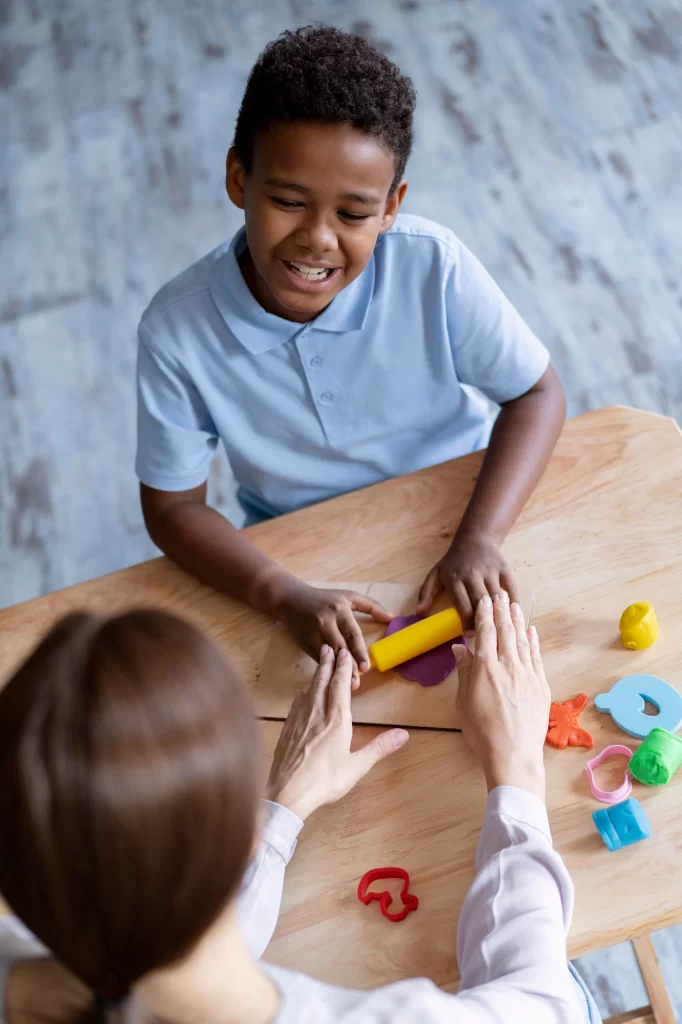
- Developmental evaluation: A trained clinician or specialist completes an evaluation using directly administered, play-based tests. One commonly used test, the ADOS-2, is a gold-standard tool that can reliably identify ASD symptoms.
- Diagnosis: The child’s doctor or psychologist will review all test results and data collected to determine if the child meets the criteria for an ASD diagnosis.
What is the best treatment for autism?
At Houston Empowering Minds Youth Service, we provide Applied Behavior Analysis therapy, widely recognized as the gold standard treatment for autism. HEMYS therapy is evidence based, meaning its effectiveness has been demonstrated through extensive scientific research.
Our data show that children who require comprehensive HEMYS therapy, defined as 25 or more hours per week, experience an average 86% reduction in challenging behaviors, including aggression, elopement, property destruction, and self-injury.
The majority of this progress occurs within the first year of treatment. Even as therapy hours are gradually reduced by approximately 20% over time, children continue to maintain meaningful and lasting improvements.
Key components of HEMYS therapy sessions
Applied Behavior Analysis uses proven behavioral principles to help children with autism build new skills and create positive, lasting changes in their lives. At Houston Empowering Minds Youth Service, our internal data shows that our HEMYS therapy approach leads to meaningful outcomes, including strong improvements in communication, daily living skills, and behavior goals.
HEMYS therapy at Houston Empowering Minds Youth Service is delivered through one-on-one sessions, where trained therapists use positive reinforcement to teach and model appropriate behaviors. New skills are broken down into clear, manageable steps to support steady progress. Each HEMYS session is individualized to meet the child’s unique needs and typically includes the following components:
- Skill development activities
- Positive reinforcement
- Structured play and social interaction
- Task repetition and mastery
- Sensory social routines
What to expect from ABA therapy for autism
Applied Behavior Analysis therapy is one of the most well-researched and effective treatments for autism. If you are considering ABA therapy for your child, here is what you can expect:
Initial autism assessment: Before therapy begins, a Board Certified Behavior Analyst (BCBA) conducts a comprehensive evaluation to understand a child’s communication skills, social interactions, behavior patterns, and sensory needs.
Individualized ABA therapy goals: Based on the assessment, the BCBA works closely with families to develop personalized therapy goals that align with the child’s strengths and priorities.
1:1 ABA therapy sessions: Autism specialists provide one-on-one sessions using positive reinforcement and evidence-based ABA techniques to help children learn new skills and reach important developmental milestones.
Family guidance and parent training: ABA therapy includes ongoing collaboration with caregivers through regular meetings with BCBAs, ensuring families receive progress updates, guidance, and support to reinforce skills at home.