ABA therapy at HEMYS
At Houston Empowering Minds Youth Service, we provide evidence-based HEMYS therapy for children diagnosed with autism spectrum disorder (ASD). Our clinically excellent HEMYS therapy takes place in bright, playful environments designed to encourage growth, play, and learning.

- Center-based therapy
Center-based ABA therapy takes place in bright, engaging environments led by dedicated therapists. Children learn communication, independence, social interaction, and school readiness skills through individualized, evidence-based strategies. Available nationwide.
- HEMYS Academy
This continuation-of-care program supports children who attend school part-time or full-time but could still benefit from additional support. It strengthens school readiness by teaching social flexibility, organization, and emotion regulation.
- HEMYS at Home
Houston Empowering Minds Youth Service at Home brings our skilled clinicians into your child’s familiar environment, helping them learn skills that naturally fit into daily routines. Families receive the same evidence-based support with added flexibility and more frequent Family Guidance.

What is ABA therapy?
Applied Behavior Analysis uses evidence-based behavioral principles to help autistic children build new skills and create meaningful, positive changes in their lives. At Houston Empowering Minds Youth Service, we use play-based teaching methods supported by research to encourage growth, learning, and engagement.
HEMYS programs are delivered through one-on-one sessions, where therapists use positive reinforcement to teach and model appropriate behaviors. Skills are broken down into small, achievable steps so each child can make steady, measurable progress.
What are target behaviors in HEMYS therapy?
In applied behavior analysis, target behaviors refer to the specific actions or habits that are the focus of therapy. These can be skills we want to teach, such as sharing toys or making eye contact, or behaviors we want to reduce, like aggression or self-injury. The goal of HEMYS therapy is not only to decrease unwanted behavior but also to teach meaningful alternatives that help children thrive at home, school, and in the community.
Our clinicians focus on two core goals during ABA therapy:
1. Understanding behavior
We look at why a behavior is happening. What is the child trying to communicate, gain, or avoid? Once we understand the function of a behavior, we can teach a more appropriate way for the child to meet the same need.
2. Teaching new skills
We begin by assessing a child’s current abilities and identifying the skills they need to build, including communication, social interaction, self-care, and school readiness. Goals are always personalized and developed in close collaboration with the family.
In many cases, challenging behaviors are linked to missing or underdeveloped skills. That is why skill development and behavior support go hand in hand. As children learn more effective ways to communicate and interact, challenging behaviors often decrease naturally.
The strength of HEMYS programs lies in the balance between science and individualization. Some children respond best to structured supports such as token boards and visual schedules, while others thrive in natural, play-based learning environments. Therapists tailor each child’s program to align with their unique strengths, needs, and learning style.

What ABA therapy methods do you use?
Our ABA therapy providers use two training methods: Discrete Trial Teaching (DTT) and Natural Environment Teaching (NET). Both methods are used to help children build meaningful skills in ways that fit their learning style and therapy goals.
Discrete Trial Teaching
DTT is an ABA technique that breaks down new skills into small, manageable steps. Each step includes a prompt, the child’s response, and positive reinforcement. This process is repeated until the child learns the new behavior or skill. DTT may consist of table work, matching games, imitation practice, and other targeted tasks, all tailored to your child’s needs and abilities. DTT is especially useful for introducing new concepts or teaching step-by-step routines.
Natural Environment Teaching
NET uses a child’s natural surroundings in an engaging play space to teach important skills. This technique can help children apply what they’re learning to real-life situations, making lessons more relevant and effective. While children lead the play experience, our clinicians are actively working on creating learning opportunities in the moment based on preselected goals. Working 1:1 with your child, our autism therapists teach skills such as appropriate play, name recognition, sharing, and motor skills through activities that the child already enjoys.

What does ABA therapy help with?
ABA therapy helps children with ASD develop meaningful and functional skills that they can apply to their everyday lives. Parents also receive training to support the generalization of these skills across different settings and with different people.
ABA Therapy can help children grow in many important areas:
Communication skills
Develop verbal and nonverbal communication skills, including speaking, using gestures, making eye contact, and understanding others
School readiness skills
Learn pre-academic skills like imitation, matching, and categorization
Behavior support
Reduce unsafe behaviors (aggression, elopement, self-injury, property destruction) by teaching safer, more effective ways to get needs met
Social skills
Promote social interaction by encouraging turn-taking, initiating conversations, engaging in play with peers, and building relationships

Reach practical goals with ABA therapy
No two children diagnosed with autism are the same. Some autistic children are nonverbal and need help developing communication skills, while others may struggle with repetitive and self-injurious behaviors. Because each child is unique, our Board Certified Behavior Analysts® (BCBAs®) set individualized goals after discussing family goals and comprehensively assessing each child’s needs.
After evaluating your child, our BCBAs will identify their current strengths and abilities as well as the areas that need skill development. We will also provide strategies for families to apply these skills in real-life situations.
We collaborate with families to set measurable goals for their child’s time with us. Our HEMYS therapy for autism is tailored to meet your family’s needs, and we focus on teaching practical skills for everyday life.
Examples of measurable goals for a child in HEMYS therapy may include:
Increase the use of spoken words to request a toy from five to 10 times a day.
Initiate playing with peers at least three times during the day.
Follow prompts during a handwashing routine in four out of five opportunities.
Identify 10 new common household objects by name.

What does a typical day of ABA therapy look like?
At Houston Empowering Minds Youth Service, ABA therapy for autism is designed to be engaging, supportive, and enjoyable for both children and families. Before therapists begin targeting specific goals, the focus is on helping each child feel safe and comfortable in their new environment. Early ABA sessions emphasize building rapport, learning a child’s interests, exploring favorite toys and activities, and understanding what motivates and delights them.
Each care team is led by a Board Certified Behavior Analyst (BCBA) and supported by a dedicated group of Registered Behavior Technicians (RBTs). Therapy is delivered under close BCBA supervision, allowing for consistent oversight and individualized attention. This team-based structure ensures children receive high-quality care, responsive support, and the focused attention they need to make meaningful progress.

You bring your child to your local Houston Empowering Minds Youth Service HEMYS therapy center in the morning. During the check-in process, you meet your child’s therapist in our lobby. Your child is in capable hands!

After the therapist welcomes your child, they head to the assigned room or play area for the first session of the day. A typical therapy session may include helping your child develop skills such as asking for a toy, matching pictures, cleaning up after themselves, or learning how to wash their hands after snack time.

Throughout the session, therapists track how well your child meets therapy goals. For example, a child might initially respond to their name correctly only 20% of the time. After many sessions and different teaching methods, they might improve to 30%, then 50%, and eventually 80%.
Your child will “rotate” to one of the other therapists on the child’s therapy team to maximize skill generalization. This means they will learn to apply what they learn in therapy to places like home or school.
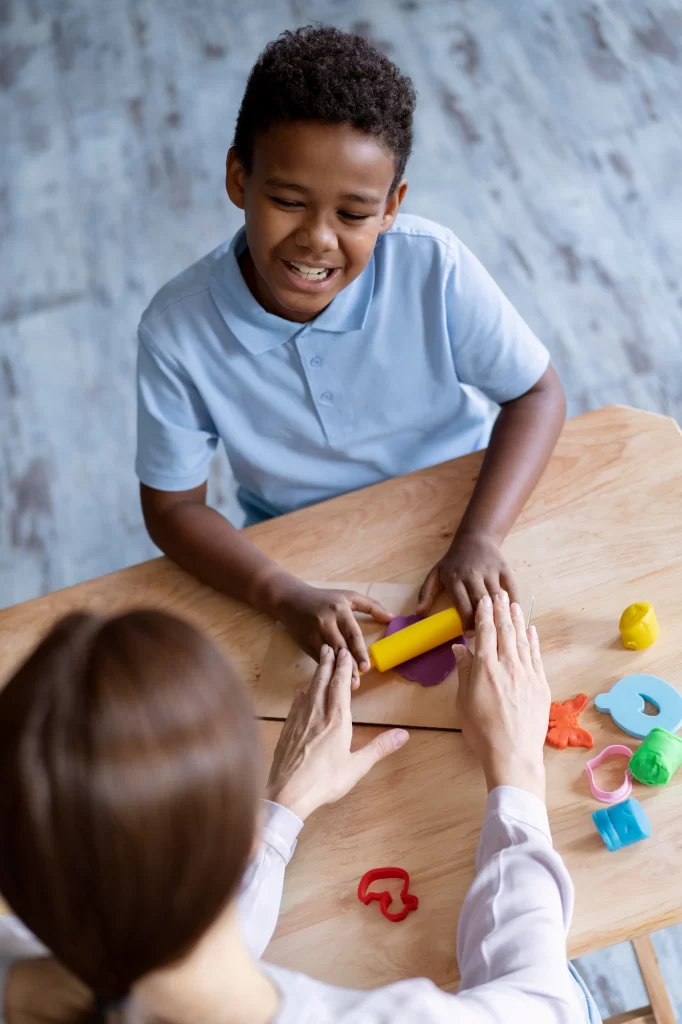
We send caregivers photos and updates throughout the day, allowing you to see what your child is doing and learning. We want you to be able to follow along with your child’s progress.

At the end of each day, caregivers pick up their children at the designated time. Your child’s safety is our top priority, and we verify the IDs of anyone picking up who is not on our approved list.

How are parents involved in ABA therapy?
Families play a vital role in the success of any ABA therapy program. Every child’s program includes twice-a-month Family Guidance sessions led by your child’s Board Certified Behavior Analyst.
During these sessions, BCBAs work directly with caregivers to:
- Set 2–4 personalized goals that reflect what’s most meaningful in your home life
- Share evidence-based strategies to help with real-life challenges, like potty training, sibling relationships, or transitions
- Teach the principles of ABA in a practical, approachable way
- Empower parents with tools and techniques to reinforce learning outside of therapy
Coordinated care, all in one place
The most meaningful clinical outcomes occur when families, HEMYS clinicians, and healthcare providers work in alignment. With your consent, your child’s BCBA coordinates care with the full support team, including pediatricians, speech therapists, occupational therapists, and other medical professionals. This collaborative approach ensures that all diagnoses and goals are reflected in your child’s individualized HEMYS treatment plan.
To make services easier to access, Houston Empowering Minds Youth Service maintains a network of approved speech, occupational, physical, and feeding therapy providers who can deliver sessions at our centers during the therapy day. This allows children to receive multiple therapies in one familiar environment, reducing transitions and travel.
Families may also choose their own outside providers. We collaborate closely with them to ensure continuity of care, because supporting your child’s growth is a shared goal.
Is ABA therapy effective?
The most meaningful clinical outcomes occur when families, HEMYS clinicians, and healthcare providers work in alignment. With your consent, your child’s BCBA coordinates care with the full support team, including pediatricians, speech therapists, occupational therapists, and other medical professionals. This collaborative approach ensures that all diagnoses and goals are reflected in your child’s individualized HEMYS treatment plan.
To make services easier to access, Houston Empowering Minds Youth Service maintains a network of approved speech, occupational, physical, and feeding therapy providers who can deliver sessions at our centers during the therapy day. This allows children to receive multiple therapies in one familiar environment, reducing transitions and travel.
Families may also choose their own outside providers. We collaborate closely with them to ensure continuity of care, because supporting your child’s growth is a shared goal.
How much does ABA therapy cost?
ABA therapy is covered by most private health insurance plans, and we are in network with many of the nation’s largest insurers. Navigating insurance can be complicated, which is why Houston Empowering Minds Youth Service’s insurance specialists handle the details for you. They verify benefits, explain coverage options, and manage the paperwork, so you can focus on what matters most: supporting your child.
Learn more about the insurance plans we accept and how we help make ABA therapy accessible and affordable for your family.
How to get started with ABA therapy
If your child already has an autism diagnosis and you are ready to begin HEMYS therapy, you can complete our brief online interest form or contact us directly. If your child is showing several early signs of autism but has not yet been diagnosed, Houston Empowering Minds Youth Service offers the following diagnostic support services:
No-cost online screening tools
For toddlers:
For older children:
Schedule an autism assessment near you
Houston Empowering Minds Youth Service provides the ADOS-2 and Initial Diagnostic Evaluations (IDEs) for children ages 18 months to 6 years. Contact us to learn about the autism diagnostic support services available in your area.